Art Response
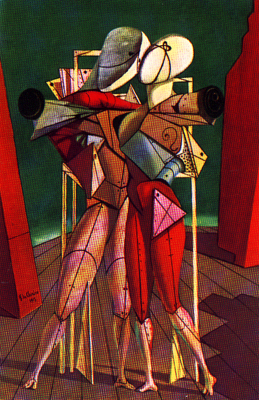
The art piece called "Hector and Andromache" was painted in oil on a canvas in 1918 by Giorgio de Chirico. This painting caught my eyes because of the the bright neutral multi-colors and shapes that the artist used. Not to mention, the two figures in such graceful gesture also something that interested me. The picture shown above was actually painted in 1917, which is not the finished one. The one that I witnessed had more bright but not gloomy colors like that one and had more details. When I first viewed the art piece, I saw the two figures first. Their gesture seemed to be gracefully and romantically leaning against one another as if they were in love. As I looked more, I noticed that there were two buildings that were on either side of them. These buildings were quite different in stucture,designs, and colors. Therefore, I concluded that Chirico must intended to capture a love scene of two different people from two different worlds like the story of "Romeo and Juliet." After a short research, I found out that "Hector and Andromache" were actually characters from the story The Iliad by Homer. Mainly, the story about those two were about Hector had to leave for war, leaving his wife Andromache and his son back. This artwork is defined as a surreal piece, which means to "disrupt our normal way of seeing things by accessing images that lurk in our subconsciouness" (handout). I also found out that a famous artist, who appreciated Chirico's artwork, is Picasso. He is known for his "cubism" artwork, which is "An art style developed in 1908 by Picasso and Braque whereby the artist breaks down the natural forms of the subjects into geometric shapes and creates a new kind of pictorial space. In contrast to traditional painting styles where the perspective of subjects is fixed and complete, cubist work can portray the subject from multiple perspectives" (www.lithokrome.com/s-47-glossary.aspx). This would explain the reasons for Chirico's choice of art; he wanted to capture the love scene of "Hector and Andromache" but also wanted for his viewers to see deeper into the scene than the general idea that everyone has at first instinct; that is why he used the cubism method for his surreal piece.

No comments:
Post a Comment